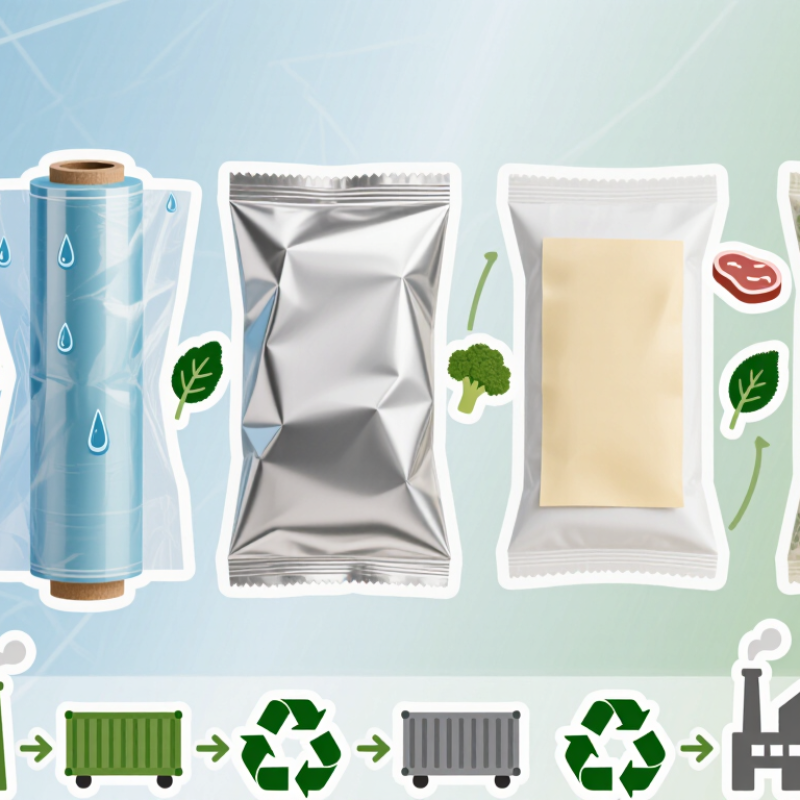
Choosing the right Food Wrap in 2026 will require more than comparing prices or claiming “eco-friendly” performance. Global buyers must match material design with product needs, processing conditions, and local recycling systems. Fresh produce may need breathable film, while meat and cheese often require stronger oxygen and moisture barriers. Bakery items demand clarity, seal strength, and dependable shelf presentation.
Industry evidence supports this practical approach. The OECD’s Global Plastics Outlook (2022) identifies packaging as the largest plastics-use sector, representing about 40% of global demand. Smithers’ The Future of Global Flexible Packaging to 2028 also highlights food packaging as a major growth driver, while emphasizing downgauging, recycling, and material efficiency. These findings suggest that lighter packaging alone is not enough. A thinner film can fail if it increases leakage, spoilage, or product waste.
Performance still matters.
Experienced buyers should compare PE cling film, PVC film, aluminum foil, coated paper, mono-material structures, and certified compostable options through measurable criteria. Important checks include food-contact documentation, seal temperature, puncture resistance, barrier performance, shelf life, and end-of-life routes. The Sustainable Packaging Coalition and WRAP repeatedly stress that recyclability depends on actual collection and sorting infrastructure, not labels alone. That point is easy to overlook.
No single wrap suits every market. A recyclable package may perform poorly in humid shipping lanes. A compostable wrap may lack suitable industrial facilities. Buyers should therefore request test reports, supplier traceability, and regional compliance evidence before scaling orders. The decision remains imperfect, but transparent trade-offs create more reliable procurement.
Food wrap is not one material or one function. Polyethylene films offer flexible sealing and moisture protection. Polypropylene tolerates higher filling temperatures and suits many hot-food applications. Paper-based wraps provide stiffness, but often need a barrier coating. Aluminum foil blocks light, oxygen, and moisture effectively. Details matter. FAO’s State of Food and Agriculture 2019 reported that about 14% of food is lost between harvest and retail. Better wrapping can reduce damage, although packaging alone cannot solve food loss.
Buyers should compare oxygen transmission rate, water vapor transmission rate, seal strength, puncture resistance, and seal initiation temperature. These terms describe real performance on a production line. A fatty snack may need strong grease resistance. Fresh vegetables may need controlled gas exchange rather than maximum sealing. Smithers’ 2024 flexible packaging analysis identifies food applications as a major demand driver, while also highlighting pressure for lighter, more recyclable structures. That pressure is real. Yet a thinner film can tear during transport.
Tips: Request test data for the exact food, filling temperature, storage period, and sealing equipment. Check migration compliance for the destination market. Ask whether the structure is recyclable in practice, not only technically. Run a small trial with stacked cartons, chilled storage, and rough handling. A wrap that performs perfectly in a laboratory may fail beside a loading dock.
Global buyers should match food wraps with product risks, not attractive packaging claims. Polyethylene film suits fresh produce, bakery items, and short chilled storage because it offers flexibility and moisture resistance. Aluminum foil protects light-sensitive foods, sauces, and heat-treated meals. It blocks light and oxygen effectively, but its energy footprint deserves attention. Paper-based wraps work well for dry bakery goods and quick-service food, especially when grease resistance is engineered into the structure.
Food safety and waste data make the choice more practical. FAO reports that 13.2% of food is lost between harvest and retail. UNEP’s 2024 Food Waste Index estimates 1.05 billion tonnes of food were wasted in 2022. A wrap that extends shelf life can therefore create measurable value, even when it uses more material.
However, this is not automatic. Poor sealing, condensation, and unsuitable storage temperatures can cancel the benefit. I have seen buyers overvalue recyclability while ignoring oxygen transmission rates and seal strength. That decision often fails during humid transport.
Tips: Request migration, barrier, and seal-performance data from suppliers. Test wraps with the actual food, filling temperature, and transport route. For oily products, check grease resistance carefully. For export orders, verify local food-contact and recycling requirements before finalizing the film structure. Small trials are cheaper than a rejected shipment.
2026 Top Food Wrap Types: What Should Global Buyers Choose?
In packaging audits, barrier performance often decides whether a food wrap protects or disappoints. Compare oxygen transmission rate, water vapor transmission rate, light protection, and grease resistance. A low oxygen rate is useful for meat, cheese, and roasted foods. However, it cannot prevent failure when seals leak or moisture enters through damaged edges. Test the complete pack, not only the film.
Safety requires documented food-contact compliance for every target market. Ask suppliers for migration reports, material specifications, traceability records, and batch-level quality data. Check whether inks, adhesives, and coatings suit the intended food type. Acidic, oily, and high-temperature foods can behave differently. “Food grade” alone is too vague. It needs evidence.
Shelf life also depends on temperature, humidity, filling conditions, and distribution time. A wrap that performs well in a cool warehouse may weaken during a humid sea shipment. Simulate real transport, including compression and repeated opening. Select plastic, paper-based, compostable, or multilayer structures according to the product’s actual risks. Cheaper material can create waste through spoilage. Yet thicker is not always better. Some buyers still compare price before testing, and that habit deserves reconsideration.
The comparison below summarizes typical performance for food-contact wrap formats. Actual results depend on material grade, thickness, sealing method, package design, food composition, temperature, humidity, and regulatory approval in the destination market.
| Food Wrap Type | Typical Material | Oxygen Barrier | Moisture Barrier | Light Barrier | Food-Contact Safety Considerations | Typical Shelf-Life Contribution | Best-Fit Applications | Key Limitations | Global Buyer Priority |
|---|---|---|---|---|---|---|---|---|---|
| Aluminum Foil | Aluminum foil, commonly used as a standalone foil or as part of a laminate | Excellent | Excellent | Excellent | Use food-contact grades compliant with the importing market. Avoid direct contact with highly acidic or salty foods during extended storage unless the structure is appropriately coated or laminated. | Very strong protection against oxidation, moisture loss, aroma transfer, and light exposure when pinhole-free and properly sealed. | Coffee, confectionery, retort or aseptic laminates, butter, processed cheese, and light-sensitive foods. | Can tear or develop pinholes; normally requires a paper or polymer layer for strength, printability, or heat sealing. Higher material and energy footprint than thin films. | Choose when maximum barrier performance is more important than transparency, recyclability simplicity, or lowest material weight. |
| Multilayer Barrier Laminate | Combinations of polyethylene, polypropylene, polyester, polyamide, aluminum, or ethylene-vinyl alcohol layers | Excellent | Excellent | Good to Excellent | Every layer, adhesive, ink, and coating must be suitable for the intended food-contact condition. Migration, odor, and overall-material compliance should be verified for the target market. | Often provides the longest shelf-life extension for oxygen-, aroma-, moisture-, or light-sensitive products when the package is correctly designed. | Dry foods, snacks, coffee, powdered products, meat, dairy, medical nutrition, and products requiring high-performance sachets or pouches. | Mixed-material construction can complicate recycling. Performance varies significantly with layer selection, thickness, and seal integrity. | Choose for demanding shelf-life targets, export logistics, and products requiring a tailored balance of barrier, strength, and sealability. |
| Polyethylene Cling Film | Low-density polyethylene or linear low-density polyethylene | Moderate | Good | Limited | Select food-contact-compliant resin and additives. Check suitability for fatty foods, freezer use, microwave use, and the specified temperature range; do not use beyond the product instructions. | Helps reduce surface drying and contamination for short- to medium-term chilled storage, but provides limited protection against oxygen and light. | Fresh produce, bakery items, prepared foods, household food covering, and chilled products with modest oxygen sensitivity. | Not ideal for oxygen-sensitive or light-sensitive foods. Poorly controlled cling, thickness variation, or weak seals can reduce performance. | Choose for flexible handling, transparent presentation, low material weight, and cost-sensitive chilled-food applications. |
| Polypropylene Film | Cast or biaxially oriented polypropylene | Good | Good | Limited | Food-contact compliance and heat-sealing performance depend on the grade and coating. Confirm suitability for hot-fill, retort, freezer, or microwave conditions before selection. | Provides better moisture and heat resistance than many basic polyethylene films; oxygen protection is improved further through coating or lamination. | Snack packaging, bakery products, confectionery, overwrap, labels, and applications requiring clarity and good stiffness. | Uncoated polypropylene is not a high oxygen-barrier material. It may require a barrier coating or laminate for long shelf-life products. | Choose when clarity, stiffness, moisture resistance, and heat performance are important. |
| Polyester Film | Polyethylene terephthalate, usually used as a film layer in a laminate | Good | Good | Limited | Use food-contact-compliant grades and adhesives. Polyester is commonly the structural or printable layer rather than the sole sealing layer. | Improves package strength, dimensional stability, puncture resistance, and printability; shelf-life performance increases when combined with a dedicated barrier layer. | Retort pouches, stand-up pouches, snack packs, bakery packaging, and high-quality printed laminates. | Usually needs polyethylene, polypropylene, or another sealant layer. By itself, it is not sufficient for the highest oxygen-barrier requirements. | Choose for strong, stable, printable packaging structures and demanding distribution conditions. |
| Coated Paper Wrap | Paper with wax, polyethylene, dispersion, bio-based, or other functional coating | Limited to Moderate | Moderate | Limited | Confirm coating, inks, adhesives, grease resistance, and direct-food-contact suitability. Fiber-based claims should be supported by the applicable local recycling or compostability rules. | Can reduce grease transfer and moisture loss for short-term storage; high-barrier coatings or laminations are required for longer shelf-life targets. | Bakery products, sandwiches, takeaway foods, dry foods, confectionery, and secondary wrapping. | Paper can lose strength when wet or greasy. Recycling compatibility depends on coating type and local collection infrastructure. | Choose when renewable fiber content, printability, and a paper-based appearance are key purchasing requirements. |
| Cellulose-Based Film | Regenerated cellulose, often with a moisture-resistant or heat-sealable coating | Good | Limited to Moderate | Limited | Coating chemistry determines grease resistance, sealability, and food-contact compliance. Compostability must be verified for the complete structure, not only the cellulose base. | Can provide useful oxygen protection for dry or moderately sensitive foods, but moisture barrier is often the limiting factor unless coated. | Dry snacks, confectionery, bakery products, tea, and applications seeking a cellulose-based film format. | Performance can decline under high humidity. Coated versions may not be accepted in every composting or recycling system. | Choose when renewable-content positioning is important and the product is not highly moisture-sensitive. |
| Compostable Bio-Based Film | Materials such as polylactic acid or certified compostable polyester blends, often with additional coatings or layers | Moderate | Moderate | Limited | Verify food-contact authorization, additives, temperature limits, and certification for the complete package. Industrial compostability does not necessarily mean home compostability or acceptance in local facilities. | Suitable for selected short- to medium-life products; barrier performance varies widely and may be lower than conventional high-barrier laminates. | Dry foods, produce bags, selected bakery items, and applications supported by an appropriate certified composting system. | Higher sensitivity to heat and humidity in some grades; end-of-life claims depend on local collection and composting infrastructure. | Choose only when verified end-of-life infrastructure and a documented product-performance match are available. |
| Silicone Reusable Cover | Food-grade silicone elastomer | Limited | Good | Limited | Use food-grade silicone intended for the relevant temperature range. Inspect for damage, odor retention, and cleanliness; it is not a sterile barrier. | Useful for repeated short-term covering and moisture retention, but generally not designed to deliver the gas barrier or hermetic seal needed for long shelf life. | Reusable bowls, cut produce, leftovers, and household storage where repeated use is practical. | Higher initial cost, limited oxygen barrier, possible odor retention, and unsuitable for many commercial high-speed packaging lines. | Choose for reusable household or food-service covering where washing, durability, and repeated use outweigh maximum barrier performance. |

Barrier rating guide: “Excellent,” “Good,” “Moderate,” and “Limited” are comparative categories for typical food-packaging formats, not universal laboratory ratings.
Safety check: Buyers should request food-contact declarations, migration test results, relevant temperature-use limits, and compliance documentation for the destination market.
Shelf-life validation: Confirm performance through package integrity testing, oxygen and water-vapor transmission testing, seal-strength testing, transport trials, and product-specific shelf-life studies.
Food wrap selection now depends on more than price and appearance. Paper wrap suits dry foods, bakery items, and short service cycles. It offers a familiar fiber texture, but grease resistance may require coatings that affect recycling. Recyclable mono-material film can protect moist foods and extend shelf life. Its value depends on local collection systems. Compostable film may fit controlled composting programs, not ordinary household bins.
Compliance should guide every specification. Buyers need food-contact declarations, migration test results, composition data, and traceable production records. Requirements differ across destination markets. A package accepted in one region may need different labeling or testing elsewhere. Check claims carefully. “Biodegradable” is often too vague. Clear disposal instructions are more useful. Small details matter, such as ink coverage, adhesive chemistry, and whether the wrap touches oily food.
Supply reliability deserves equal attention. Ask suppliers about resin or pulp sources, coating capacity, roll-width tolerance, and seasonal lead times. Request samples from several production lots, not one perfect shipment. Test sealing strength after refrigeration and heat exposure. We have seen sustainable materials fail when humidity changes. That weakness is easy to miss during a showroom review. A lower-impact material may also require thicker gauges, increasing total material use. Buyers should compare the full package system, including waste handling, transport distance, minimum order quantities, and realistic end-of-life conditions. Perfect choices are rare. Better decisions come from measured trade-offs.
Global buyers need a decision framework, not a fashionable material. In 2026, food wrap selection should begin with product risk. Fresh meat, bakery items, and dry snacks require different oxygen, moisture, and grease barriers.
Smithers’ 2024 flexible packaging report valued the global market at roughly US$300 billion in 2023. It also forecasts continued growth through 2028. Performance comes first. Test seal strength, puncture resistance, print durability, and shelf-life performance on the actual filling line. Polyethylene and polypropylene films often provide reliable sealing and moisture protection. Paper can improve shelf appearance, but coatings may complicate recycling. Compostable film is not automatically suitable; local collection systems and industrial composting access matter. A perfect wrap rarely exists. Buyers must accept trade-offs.
UNEP’s Food Waste Index Report 2024 estimated 1.05 billion tonnes of food waste in 2022. A stronger barrier may prevent waste, even when its disposal route looks less attractive. Yet this logic needs evidence, not assumptions.
Tips: Compare the wrap’s full life cycle, not only its unit price. Request migration and shelf-life test reports. Check sealing temperatures with your equipment. Confirm disposal guidance in each destination market. Ask suppliers for batch consistency data. Small tests reveal expensive mistakes.
A practical framework for comparing food wrap materials by barrier protection, heat suitability, recycling practicality, and reusability.
Scores use a comparative 1–5 scale based on commonly reported material characteristics. Higher scores indicate stronger suitability for that criterion. Actual performance depends on film thickness, coating, food type, temperature, packaging design, and local recycling infrastructure.