Leave Your Message
Why Choose Biodegradable Bags for Global Packaging?
Global packaging is under measurable pressure. The OECD’s Global Plastics Outlook reported 353 million tonnes of plastic waste in 2019, while only 9% was recycled. The United Nations Environment Programme warns that plastic pollution could nearly triple by 2060 without major intervention. These figures make Biodegradable Bags relevant for retailers, manufacturers, and logistics teams seeking lower-impact packaging choices.
The opportunity is growing. European Bioplastics and nova-Institute reported global bioplastics production capacity of about 2.18 million tonnes in 2023. Packaging represented the sector’s largest application, at approximately 43%. However, not every bio-based bag is biodegradable. That distinction matters. Performance, certification, disposal access, and local infrastructure must be checked before procurement. A bag that breaks down in an industrial composting facility may remain intact in a landfill or marine environment.
Real conditions matter.
François de Bie, former chairman of European Bioplastics, said, “Bioplastics are not only a material of the future, they are already here today.” His statement reflects market momentum, but it should not end the discussion. Responsible packaging decisions need evidence from lifecycle assessments, recognized standards, and supplier documentation. EN 13432 and ASTM D6400 can help verify industrial compostability claims, although requirements differ by market. For example, a food distributor may need a certified bag, clear disposal labels, and stable performance in humid warehouses. Biodegradable Bags can support a more circular packaging strategy, but they are not a magic solution. Consumer behavior still matters. Infrastructure matters more.
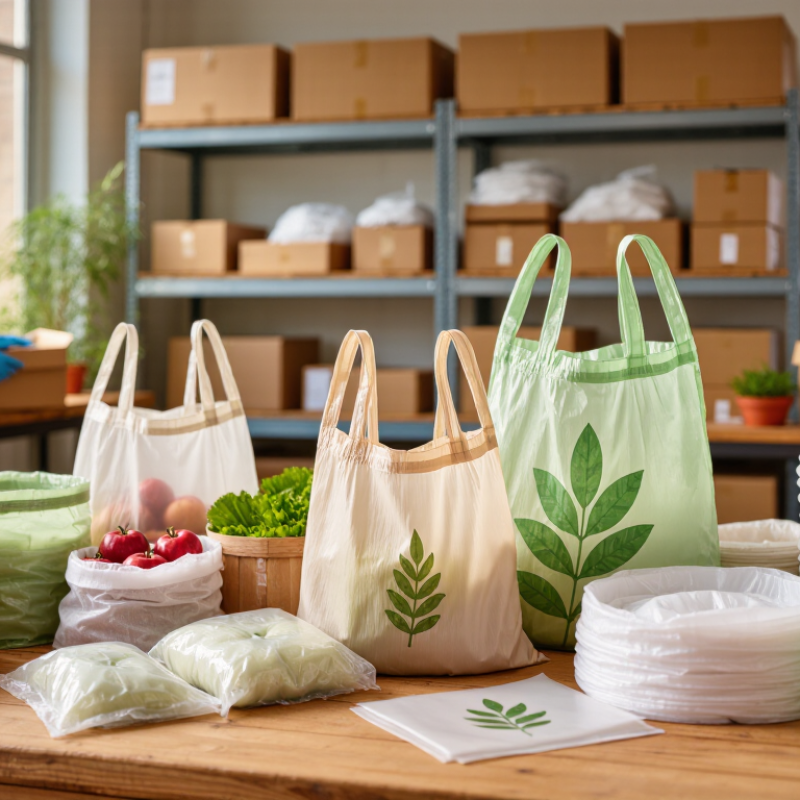
Why Choose Biodegradable Bags for Global Packaging?
Biodegradable bags are packaging products designed to break down through biological activity. Microorganisms, moisture, oxygen, and temperature all influence this process. Some bags use plant-based materials, such as starch or cellulose. Others combine biodegradable polymers with carefully tested additives. The material alone does not guarantee quick decomposition. Industrial composting may be required, while ordinary soil can produce different results. That distinction matters.
In practical packaging assessments, I look beyond the label. A useful bag should have suitable strength, reliable sealing, and clear disposal guidance. A bag carrying fresh produce may need moisture resistance, while a lightweight garment bag needs flexibility. Biodegradable options can reduce long-term plastic persistence, but their environmental value depends on production, transport, and disposal. The word “biodegradable” still feels too broad. I once assumed it meant “breaks down anywhere.” That assumption was incomplete.
Tips: Check the bag’s material details and recognized certification. Confirm whether local facilities accept it. Keep biodegradable bags away from regular recycling streams unless local guidance allows them. Store them in a cool, dry place before use. Avoid claims that promise instant decomposition. Good packaging decisions require evidence, not attractive wording.
| Data Dimension | Biodegradable Bags | Why It Matters for Global Packaging |
|---|---|---|
| Definition | Bags designed to be broken down by microorganisms into substances such as water, carbon dioxide or methane, biomass, and mineral salts under suitable environmental conditions. | Provides an end-of-life pathway that differs from conventional plastics, which can persist in the environment for very long periods. |
| Common Material Categories | May be made from biodegradable polymers, starch-based materials, cellulose-based materials, or blends of bio-based and fossil-based polymers. | Material selection can be matched to the required strength, barrier performance, shelf life, and disposal infrastructure. |
| Biodegradable vs. Compostable | “Biodegradable” describes biological breakdown but does not, by itself, specify the time, location, temperature, or residue requirements. “Compostable” generally refers to breakdown under defined composting conditions without harmful residues. | Clear terminology helps prevent incorrect disposal claims and improves communication across international markets. |
| Industrial Composting Conditions | Many certified compostable bags require controlled facilities with elevated temperatures, moisture, oxygen, and active microbial conditions. They may not break down effectively in a backyard compost bin, soil, landfill, or marine environment. | Packaging programs should identify whether suitable collection and industrial composting facilities are available in the destination market. |
| Relevant International Test Frameworks | Examples include EN 13432 for packaging recoverable through industrial composting and biodegradation, ASTM D6400 for compostable plastics, ASTM D5338 for controlled composting testing, and ASTM D5988 for aerobic biodegradation in soil. | Recognized test methods make performance claims more comparable and help support market-specific compliance reviews. |
| Typical Industrial Composting Timeframe | Under EN 13432-type requirements, biodegradation is assessed over a period of up to 180 days, while disintegration is assessed over approximately 12 weeks under specified test conditions. | Actual performance depends on facility conditions, bag formulation, thickness, moisture, temperature, and sorting quality. |
| Renewable Feedstock Potential | Some biodegradable bags use agricultural or forestry feedstocks, such as starch or cellulose. A bio-based origin does not automatically mean that a product is biodegradable or compostable. | Separating “bio-based” from “biodegradable” supports more accurate environmental comparisons and procurement decisions. |
| Functional Performance | Available designs can provide carrying strength, flexibility, printability, and moisture resistance, but performance varies by material, thickness, formulation, and storage conditions. | Packaging specifications should be tested for the intended load, humidity, temperature range, transport distance, and product type. |
| End-of-Life Requirement | Biodegradable or compostable bags should be separated according to local waste rules. They should not automatically be placed in recycling streams because they may contaminate conventional plastic recycling. | Correct labeling, consumer instructions, and compatible collection systems are essential for achieving the intended environmental benefit. |
| Environmental Benefit | Potential benefits include reduced dependence on persistent conventional plastic and compatibility with organic-waste recovery systems where certified products and suitable infrastructure exist. | Benefits are greatest when material production, transport, use, collection, treatment, and disposal are evaluated as a complete life cycle. |
| Important Limitation | No biodegradable bag should be assumed to disappear rapidly in nature. Littering remains harmful, and degradation rates can be much slower or incomplete outside the tested conditions. | Responsible packaging decisions require verified claims, appropriate disposal instructions, and a realistic assessment of local infrastructure. |
| Reference basis: International and regional requirements commonly associated with EN 13432, ASTM D5338, ASTM D5988, and ASTM D6400. Test results apply only to the specified material, product design, and laboratory conditions; they should not be interpreted as guaranteed behavior in every natural environment. | ||