What Are Degradable Bags and How Do They Work?
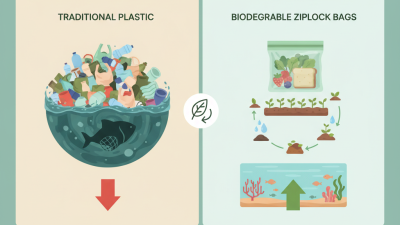
A thin shopping bag may look simple, but its material can behave very differently after use. Degradable Bags are designed to break down through processes such as exposure to heat, moisture, oxygen, or microorganisms. The exact process depends on the bag’s material and how it was made. Some products use additives that help the plastic fragment under particular conditions; others are made from materials that microorganisms can consume. These outcomes are not interchangeable. A bag becoming smaller pieces does not necessarily mean it has fully biodegraded.
The terminology is not always tidy. That matters. A bag may need specific conditions, such as managed composting, to break down as claimed, and those conditions may not exist in a backyard or roadside setting. Temperature, humidity, sunlight, and time can all affect the result. For shoppers and businesses, the useful details are the product’s material, its stated disposal route, and any test or certification information provided by the manufacturer. Treat broad claims with care. A label alone cannot show what will happen in every environment, and even well-designed bags can be disposed of incorrectly. Understanding how a bag works helps people compare options without assuming that “degradable” means harmless, instant, or suitable for every waste stream. The details deserve a closer look.
What Degradable Bags Contain: Starch, PLA, PBAT, and Oxo-Additives
Degradable bags are not made from one standard recipe; the label can describe materials that behave very differently after use. Starch, often sourced from crops, is commonly blended with polymers rather than used alone. It can reduce the share of fossil-based material, but starch alone may make a bag brittle or sensitive to moisture. PLA, a plant-derived polyester, can add stiffness and clarity. Yet many PLA products need controlled industrial composting conditions; they may persist in cool soil, seawater, or a backyard compost pile. Not automatic.
PBAT is a flexible polyester often paired with starch or PLA, helping a thin bag stretch without tearing as easily. Some formulations can biodegrade under specified composting conditions, but the blend and facility matter. Oxo-additives work differently: they encourage oxidation and fragmentation with heat, light, and oxygen. Smaller pieces are not proof of complete biodegradation. That distinction deserves attention. Even a careful reader can flatten these differences when a label gives little detail. Check the material description, test conditions, and local disposal guidance; the word “degradable” alone does not tell you where a bag belongs.
How Degradation Starts: Microbes, Oxygen, Water, Heat, and Light
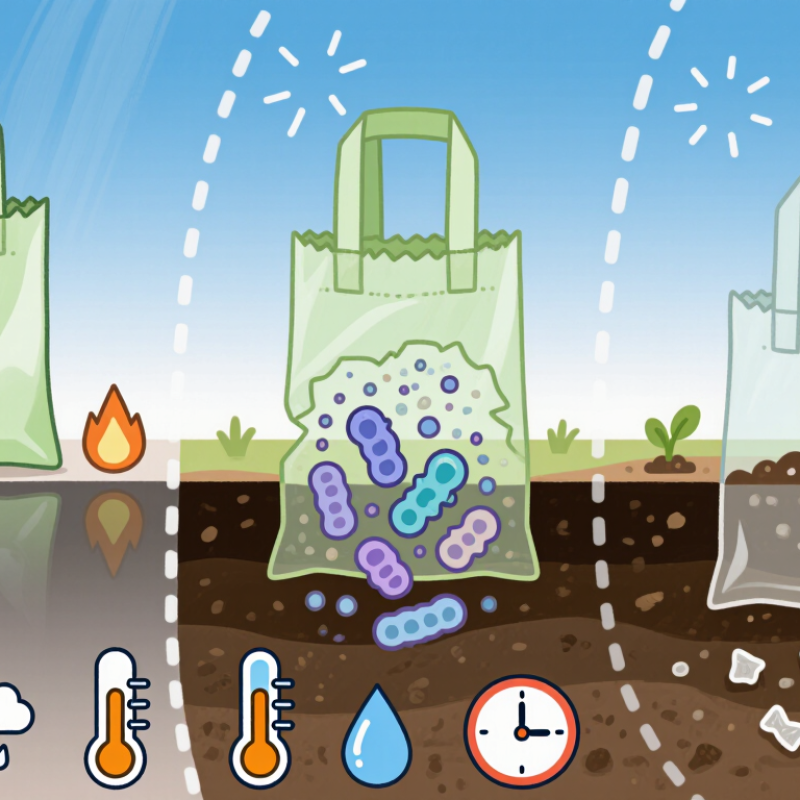
Degradation rarely begins with a bag simply disappearing. Sunlight, warmth, and oxygen can weaken some materials, changing their long polymer chains into smaller fragments. A dark, dry cupboard slows many of these reactions. Conditions matter.
Water can enter certain materials and help break chemical bonds, while heat may speed those reactions. Light can trigger oxidation at the surface, sometimes making a bag brittle or causing cracks. Microbes may then use suitable breakdown products as food, especially when moisture and oxygen are available. It is gradual.
The sequence differs by material. Some bags need industrial composting conditions, including controlled heat and moisture; they may persist in cool soil or a landfill. Others may fragment without being fully converted into water, carbon dioxide, and biomass. That distinction is easy to miss. Look for specific disposal instructions, and avoid assuming that “degradable” means the bag will break down quickly in any setting. A damp garden bed, for example, is not the same as a managed composting facility. Even with good information, real-world conditions can be uneven.
Why Conditions Matter: Industrial Composting Versus Soil and Marine Environments
Degradable bags do not all break down in the same way. Their materials need particular combinations of heat, moisture, oxygen, and microorganisms. The word “degradable” alone does not tell you where or how quickly a bag will break down. That detail matters.
Industrial composting sites manage conditions more closely than a backyard pile. They maintain warmth, moisture, and airflow, giving suitable materials a better chance to decompose. Some bags are tested for these facilities, but that does not mean they will break down in home compost. Check the product information and whether your local facility accepts it. Not every facility does.
Soil and marine environments are far less predictable. A bag buried in cool, dry, or compacted soil may break down slowly; pieces can remain visible. In seawater, lower temperatures and different microbial activity may also delay breakdown. Currents can carry fragments away from where they entered the water. “Degradable” does not mean harmless or quick to disappear. It is easy to assume that a bag will vanish anywhere. That assumption needs a second look. Conditions, testing, and disposal routes all shape what happens next.
Degradable Bags: Why Test Conditions Matter
These bars compare test temperatures—not how quickly a bag will degrade. Industrial composting tests use much warmer conditions than soil or marine tests. The soil bar shows the midpoint of its 20–28°C test range. Actual breakdown depends on the material and the full set of conditions; a bag designed for industrial composting should not be assumed to break down in soil or seawater.
Reference test conditions: EN 13432 (industrial composting, 58 ± 2°C); ISO 17556 (soil, 20–28°C); ISO 18830 (marine environment, 20 ± 2°C).
What EN 13432 Requires: 90% Biodegradation in 6 Months and Disintegration in 12 Weeks
What Are Degradable Bags and How Do They Work?
A degradable bag is designed to break down through biological activity under specified conditions. The word “degradable” alone can be vague. It does not guarantee that a bag will disappear in a garden, roadside ditch, or ocean. EN 13432 sets measurable requirements for packaging intended for industrial composting.
Under the standard, at least 90% of the bag’s organic material must biodegrade within six months in controlled composting tests. Microorganisms convert the material into carbon dioxide, water, and biomass. The test environment provides managed heat, moisture, and oxygen. It is not the same as leaving a bag in a cool backyard compost bin.
Conditions matter.
Disintegration is tested separately. Within 12 weeks, the material must break apart so that no more than 10% of its original dry mass remains on a two-millimeter sieve. That is not quite the same as biodegradation. Small fragments may be hard to see, but they still need to meet the standard’s requirements.
The finished compost is also assessed for effects on plant growth and for regulated substances. In practice, check whether local composting facilities accept certified bags; many do not. Labels can be confusing, and I would not assume “compostable” means suitable for every compost pile.
How ASTM D6400 Tests Compostable Bags: Controlled Composting Over 180 Days
ASTM D6400 evaluates whether a plastic bag can compost under managed, industrial conditions. The test uses controlled heat, moisture, oxygen, and active compost microbes. It is not a backyard compost test. Conditions are monitored because a dry or cool pile can behave very differently.
Over a period of up to 180 days, laboratories measure biodegradation by tracking how much carbon becomes carbon dioxide. The material is compared with a reference substance. The standard also checks disintegration: after composting, large visible fragments must be limited. Screening matters. So do checks for substances that could harm compost quality, including tests involving plant growth. A bag that merely breaks into smaller pieces has not necessarily passed; fragmentation alone does not prove biodegradation.
The distinction is easy to miss. A bag may look thinner or tear apart in a home compost bin, yet fail to meet the test’s controlled conditions. Results apply to the tested material and thickness, not automatically to every bag with similar labeling. In practice, composting facilities also differ in temperature, processing time, and acceptance rules. That gap can be frustrating. ASTM D6400 provides a measured benchmark, but it does not guarantee that every facility will accept or fully process a particular bag.